The tiles
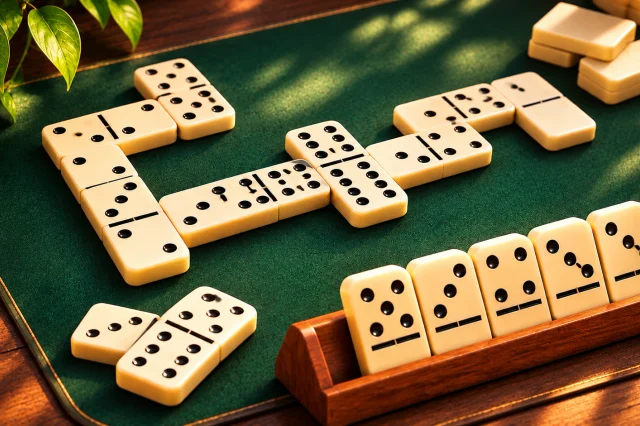
A standard set has 28 tiles, each with two ends showing 0 to 6 dots. There are seven doubles, such as 4-4 or 6-6, where both ends are the same. The total number of dots in the set is 168. The tiles are shuffled face down and called the bones.
The deal and the opening
With two players, each takes 7 tiles. With three or four players, each takes 5. The tiles left over are the boneyard, which stays face down for drawing.
The player holding the highest double opens by playing it. If no double was dealt, the player with the highest tile, counted by total dots, opens instead. Play then passes to the left.
How a turn works
- Look at the two numbers at the open ends of the chain.
- Play a tile from your hand that has the same number of dots as one of those ends, and place it so the matching ends touch. Doubles go across the chain.
- If you have no tile that fits, draw tiles from the boneyard one at a time until you can play one.
- If the boneyard is empty and you cannot play, you pass.
On boardflix the tiles you can play are lifted. Drag a tile onto a glowing end of the chain, or tap it. If a tile fits at both ends, drag it to the end you want, or tap it and then tap the end.
Winning and scoring
In the All Fives style, you also score while you play: whenever the two open ends of the chain add up to a multiple of five (a double at an end counts both halves), the player who made that play scores that many points straight away. At the end of an All Fives round, the winner's points are rounded to the nearest five.
A round ends when a player plays their last tile, which is called going out. That player scores all the dots left in the other players' hands. If nobody can play and the boneyard is empty, the round is blocked: the player with the fewest dots wins and scores the difference between the total of everyone else's dots and their own.
A match is played to a target score, such as 50, 100 or 150, over several rounds. You can also play a single round, where the winner of the round wins the game.
Tips for winning
- Play your heavy tiles early. The dots left in your hand count against you if someone else goes out first.
- In All Fives, look for plays that leave the two ends adding up to 5, 10, 15 or 20, and try to leave ends that do not give your opponents an easy five.
- Get rid of doubles while you can. A double can only be played on its own number, so it is harder to place later.
- Keep a mix of numbers in your hand, so you are less likely to be stuck and forced to draw.
- Pay attention to what the other players cannot match. When someone draws or passes, they have none of the numbers at the ends, and you can use that to block them.
- Try to leave a number at the end of the chain that you hold plenty of tiles for, and your opponents may not.
- In a blocked game, the dots in your hand decide the winner, so keep your hand light.
Playing Dominoes on boardflix
Choose how many computers join you, from one to three, and pick Easy, Medium or Hard. The Hard players notice which numbers you cannot match and play to block you. Pick the target score or play a single round. The tiles are shuffled with secure random numbers, and in a private room the server holds every hand, so no player can see another's tiles. Up to four people can join a room with a code, and if someone leaves, the computer plays their tiles.
Frequently asked questions
Who goes first in Dominoes?
The player with the highest double starts by playing it. If nobody has a double, the player with the highest tile starts.
What happens if I cannot play?
You draw tiles from the boneyard until you can play one. If the boneyard is empty, you pass.
How do I score?
When a player goes out, they score the dots left in all the other hands. In a blocked round, the lowest hand wins and scores the difference.
What is a blocked game?
A blocked game is one where nobody can play and the boneyard is empty. The round ends and the player with the fewest dots wins.
How many tiles are in a set?
A double-six set has 28 tiles. Every combination of two numbers from 0 to 6 appears once.
Can I see the other players' tiles?
No. You only see your own tiles until the round ends, when every hand is shown.