The board: a grid of dots
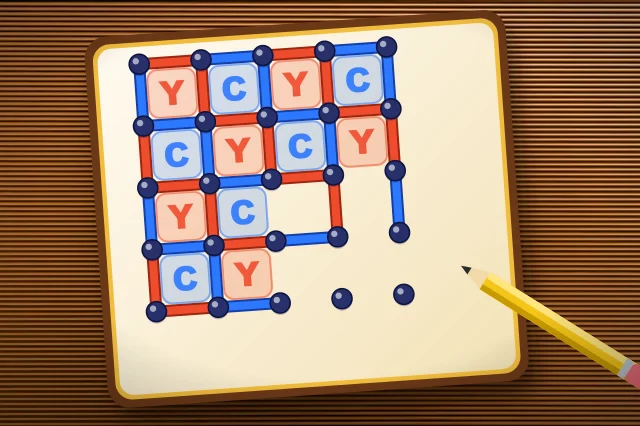
The board is a square grid of dots. A board of 5 by 5 boxes has 6 by 6 dots, and the spaces between the dots are the boxes. On boardflix you can choose 3 by 3, 4 by 4, 5 by 5 or 6 by 6 boxes. Small boards are quick and good for learning, and the larger ones give room for long chains and real planning.
How a turn works
- Draw one line between two neighbouring dots, either across or up and down. You cannot draw a diagonal line or draw over a line that is already there.
- If your line completes the fourth side of a box, you claim that box: it fills with your colour and your initial.
- If you claimed a box, you must draw another line. You keep going as long as every line you draw closes a box.
- If your line did not close a box, the turn passes to your opponent.
One line can close two boxes at the same time, when it is the last missing side of both. That scores two boxes and still earns another line.
How the game ends and who wins
The game ends when every box has been claimed. The player with more boxes wins. On a board with an odd number of boxes (3 by 3 or 5 by 5) one player always has more, so there are no draws. On a board with an even number of boxes (4 by 4 or 6 by 6) the game can end level.
The rule that decides everything: do not draw a third side
If you draw the third side of a box, your opponent can close it, take the box and draw again. So early in the game you try to draw lines that do not leave any box with three sides. These are called safe lines. At first there are plenty of safe lines, but as the board fills up they run out, and whoever has to draw the first unsafe line must give boxes away.
This is why the opening of dots and boxes feels slow and careful, and why the end feels sudden: once the safe lines are gone, boxes fall in groups.
Chains, loops and sacrifices
When the safe lines run out, the board is made of chains and loops. A chain is a row of boxes where each box has two sides drawn and is joined to the next, like a corridor. A loop is a chain that closes into a ring. Drawing any line in a chain gives your opponent the whole chain, one box after another, because each box they close leaves the next box with three sides.
Giving away boxes on purpose is called a sacrifice. When you must open a chain, open the shortest one first, so your opponent gets as few boxes as possible. Chains of one or two boxes are cheap to give away, and chains of three or more are expensive.
Keeping control: the double-cross
Here is the idea that makes dots and boxes a game of skill. Suppose your opponent opens a long chain for you. You could take every box, but then you must draw another line, and with no safe lines left you will have to open the next chain for them. A stronger move is to take all the boxes except the last two, and then draw the line that gives those two away in one piece. Your opponent takes the two boxes, but now they must open the next chain for you. You gave up two boxes to keep control of the game.
This is called a double-cross or double-dealing move. It is worth it when the chains still to come are long, because the boxes you win later are worth more than the two you gave up. The Hard computer on boardflix finds these moves by checking every possible ending, so it never misses one in the endgame.
The long chain rule
There is a famous rule of thumb about who ends up in control. A long chain is a chain of three or more boxes. If the board has an even number of dots, the first player should try to make an odd number of long chains in total, and the second player should try to make an even number. If the number of dots is odd, it is the other way round. A 5 by 5 board has 36 dots, an even number, so the first player wants an odd number of long chains.
You do not need the rule to enjoy the game, but it explains a lot: much of the fight in the middle game is about whether the board will end up with one long chain, two or three.
Tips for winning
- Always close a box when you can, unless you are deliberately keeping control with a double-cross near the end.
- Draw safe lines for as long as you can, and count how many safe lines are left. The player who runs out first is usually in trouble.
- When you must give boxes away, give away the smallest group.
- Try to shape the board so that the long chains come out in your favour, using the long chain rule.
- Look for lines that close two boxes at once: they are worth double.
Playing dots and boxes on boardflix
Choose a board size and play the computer on Easy, Medium or Hard, or pass the device to a friend. Boxes that you can close right now are marked with a dashed outline, so you never miss one. Lines draw with a pencil sound, and closing a box has its own chime. In a private room two people play over the internet, the host chooses the board size, and if someone leaves, the computer takes over their side.
Frequently asked questions
Do I get another turn when I close a box?
Yes. Closing a box gives you another line to draw. You keep drawing for as long as your lines close boxes.
Can one line close two boxes?
Yes. If a line is the last missing side of two neighbouring boxes, you claim both and draw again.
Can dots and boxes end in a draw?
On boards with an even number of boxes, such as 4 by 4 and 6 by 6, the game can end level. On 3 by 3 and 5 by 5 boards one player always wins.
What is a safe line?
A line that does not leave any box with three sides drawn. Drawing a third side lets your opponent close the box, so you draw safe lines for as long as possible.
What is a double-cross?
Giving up the last two boxes of a chain in one piece, instead of taking them, so that your opponent has to open the next chain for you.
Who goes first?
In a private room the first player alternates with each rematch. Against the computer, you start.