The board and the stones
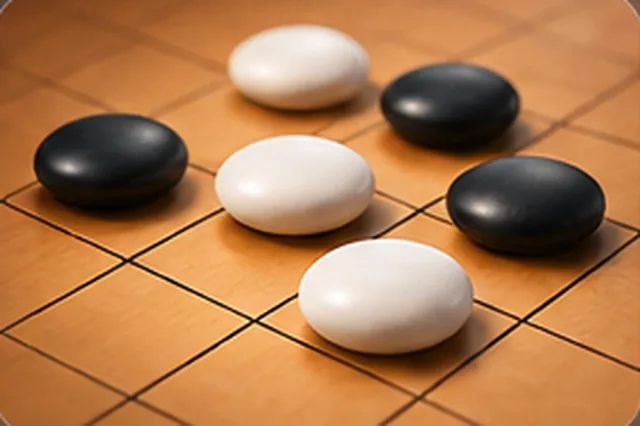
The board is a 15 by 15 grid and stones are placed on the crossing points of the lines, not inside the squares. Black moves first. The version on boardflix is freestyle Gomoku, the simplest set of rules.
How a turn works
- Black and white take turns placing one stone on any empty crossing.
- A stone never moves and is never captured.
- After each stone, check for a line of five and for any threat you have to block.
How to win
You win by creating a sequence of five or more of your stones in an unbroken line across, down or along a diagonal. In freestyle Gomoku a line of six or more also wins. If the whole board fills without a line, the game is a draw, though this almost never happens.
Threes, fours and forks
Every strong move creates a threat. An open three is three stones in a row with free space at both ends. If your opponent ignores it, you turn it into an open four, which cannot be stopped because they can only block one end. So an open three must be answered at once.
A four with one end already blocked is also a forcing move, because you win next turn unless your opponent blocks the open end. Strong players chain these forcing moves together until the opponent runs out of answers.
The key winning pattern is the four-three: one stone that makes a four and an open three at the same time. Your opponent has to block the four, and then you finish the three into an open four.
Opening tips
- Play your first stones near the centre. They have room to make lines in every direction.
- Keep your stones connected. Stones that are two apart in a line are often as useful as stones that touch, and harder to attack.
- Do not build a long line on the edge. A line that touches the edge has fewer ways to grow.
- Black has an advantage from moving first, so White should block early and play for the centre.
Defence is as important as attack
When you cannot attack yet, look at where your opponent's lines cross and play there. A stone that blocks two of their lines at once is worth far more than one that only extends your own line. Before each move, imagine you were the opponent and ask where you would play.
Common mistakes
- Ignoring an open three.
- Starting at the edge of the board.
- Making a single threat that is easy to block.
- Blocking the end of a line that is not dangerous yet.
Playing Gomoku on boardflix
Choose Easy, Medium or Hard, or play a friend on the same screen. The Undo button takes back a move while you are learning. To play online, create a private room and share the link.
Frequently asked questions
Does a line of six stones win?
Yes. In freestyle Gomoku five or more stones in a row win.
Why does Black have an advantage?
Black places the first stone and is always one move ahead. Tournament rules limit Black to reduce this, but freestyle keeps things simple.
Where should I play my first stone?
Near the middle. Stones in the centre have room to make lines in every direction.
Is Gomoku the same as Rowdy Jacks?
No. Gomoku, sometimes called five in a row, is played on a plain grid with stones. Rowdy Jacks on this site is a different game played with cards and chips.