The board and the pieces
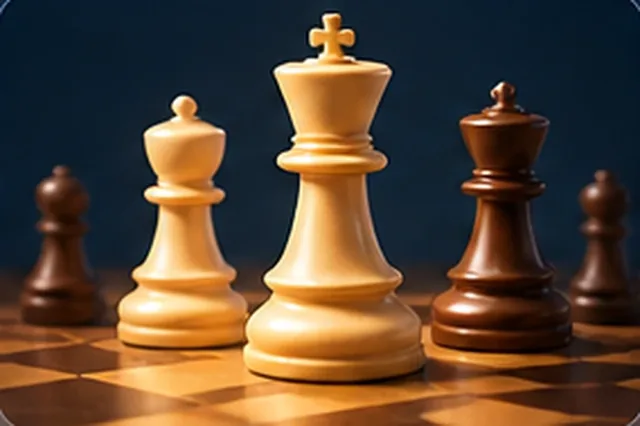
The board has 64 squares in two colours. Set it so each player has a light square at their right-hand corner. Each side has one king, one queen, two rooks, two bishops, two knights and eight pawns. White always moves first.
How each piece moves
- The king moves one square in any direction.
- The queen moves any number of squares in a straight line or along a diagonal.
- A rook moves any number of squares along a row or column.
- A bishop moves any number of squares along a diagonal, so it always stays on one colour.
- A knight moves in an L shape, two squares one way and one square to the side, and it is the only piece that can jump over others.
- A pawn moves one square forward, or two squares on its first move, and captures one square diagonally forward.
Check, checkmate and stalemate
When a king is attacked it is in check, and the player must get out of check at once: move the king, block the attack or capture the attacker. If there is no way out, that is checkmate and the game is over. A player may never make a move that leaves their own king in check.
If a player has no legal move but is not in check, the game is a draw called stalemate. Other drawn games include a position where neither side has enough pieces to checkmate and a position repeated three times.
Special moves
- Castling: the king moves two squares towards a rook and the rook jumps over it, if neither has moved, the squares between them are empty and the king is not in check or passing through check.
- En passant: a pawn that has just moved two squares can be captured by an enemy pawn as if it had moved only one, but only on the very next move.
- Promotion: a pawn that reaches the far row is replaced by a queen, rook, bishop or knight of the same colour, usually a queen.
Opening principles
- Fight for the centre with your pawns.
- Bring your knights and bishops out early, before the queen and rooks.
- Castle quickly so your king is safe and your rook joins the game.
- Do not move the same piece twice in the opening without a good reason.
- Look at what your opponent just threatened before every move.
Tactics every beginner should know
A fork is one move that attacks two pieces at once, and knights are especially good at it. A pin freezes a piece because moving it would expose a more valuable piece behind it. A skewer is the reverse: the valuable piece is attacked first and must move, which exposes the one behind. Spotting these in your own games wins material quickly.
Piece values help you judge a trade: a pawn is worth about one point, knights and bishops about three, a rook about five and the queen about nine. Giving up a queen for a rook and a pawn is usually a mistake.
The endgame
When most pieces are gone the king becomes a fighter, so bring it to the centre. Push passed pawns, which are pawns with no enemy pawn in front or beside them, and learn how a king and queen checkmate a lone king. If you are ahead in material, trade pieces. If you are behind, keep them on the board.
Common mistakes
- Bringing the queen out too early and chasing it around.
- Forgetting to look for the opponent's threats.
- Capturing without checking whether the capturing piece will be taken back.
- Leaving pieces undefended.
Playing chess on boardflix
Play the computer on Easy, Medium or Hard, or take turns with a friend on one screen. To play someone far away, create a private room and share the link. Colours are assigned in the room and a rematch swaps them.
Frequently asked questions
Who moves first?
White always moves first.
What is the difference between checkmate and stalemate?
In checkmate the king is attacked and cannot escape, so the attacker wins. In stalemate the player to move has no legal move but is not in check, and the game is a draw.
What is castling for?
Castling tucks your king behind its pawns and brings a rook into play in a single move.
How many moves does a game take?
Most games last between 30 and 60 moves each, though short games can end in a few moves.
What should I learn first?
Learn how the pieces move, then the opening principles, and then practise spotting forks and pins.