The board: 100 squares, HOME, ladders and snakes
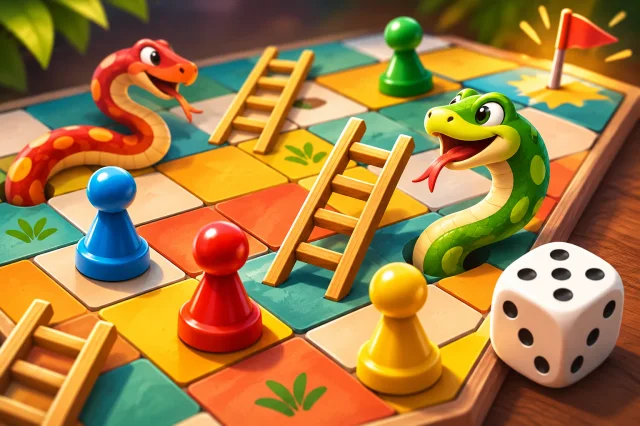
The board is the classic cut-corner layout: a grid of eleven rows with a picture in each corner, so the top and bottom rows are shorter than the middle ones. The squares are numbered from 1 at the bottom and snake back and forth up the board, the way you read a page of a zig-zag, until square 100, and the very last square is marked HOME. Squares are coloured red, yellow, green and blue so they are easy to tell apart.
Ladders and snakes connect pairs of squares. A ladder joins a lower square to a higher one, and a snake joins the square where its head is to a lower square where its tail is. On boardflix the board has eleven ladders and twelve snakes, so there are plenty of chances to climb and a real risk of being bitten, and some of the ladders are long enough to carry you across half the board.
How a turn works
- Roll the die. Everyone starts off the board, in the start lane under square 1, so your first roll brings your pawn onto the board.
- Move your pawn that many squares, counting up the numbers.
- If you stop on the foot of a ladder, climb it to the top. If you stop on a snake's head, slide down to its tail.
- If you rolled a 6, roll again. Three 6s in a row lose that move and the turn passes.
Ladders and snakes are only used when you stop exactly on their first square. Passing over one does nothing, and a pawn that lands at the top of a ladder or the tail of a snake stays there until its next turn.
Winning: the exact roll to finish
To win you must land on HOME exactly. If your roll is too big, you stay where you are and the turn passes. For example, on square 98 you need a 3 to reach HOME, and a 4, 5 or 6 does not move you. This is the part of the game that makes the end exciting, because a pawn can wait several turns on a square close to the finish.
Playing with two, three or four players
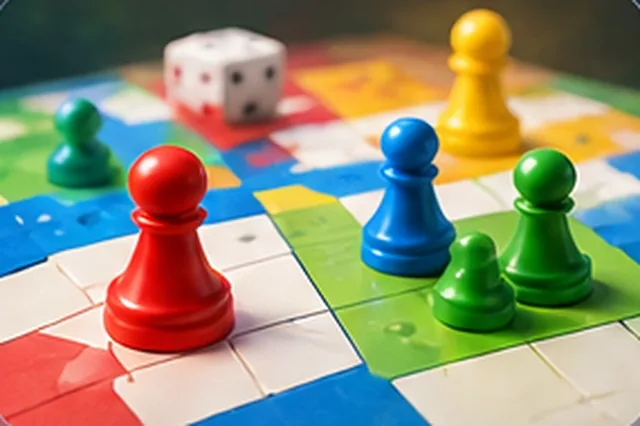
Each player has one pawn in their own colour. Pawns can share a square: there is no capturing in snakes and ladders, so nobody is sent back by another player. With more players the game takes longer, but each turn is still just one roll.
Is there any strategy?
Snakes and ladders is a game of pure chance: the die decides everything, and there are no choices to make once the board is set. That is why it is a good first game for young children and a relaxed game for a family evening. What you can do is enjoy the swings. A pawn on square 80 can be on square 20 two turns later, and a pawn on square 5 can be on square 50.
If you want to understand the game better, think about probabilities. The most useful squares are just below a ladder, because each of the six numbers on the die has the same chance, so a ladder foot one to six squares ahead is reached with roughly one chance in six per turn. The most dangerous squares are the ones one to six squares before a snake's head.
Where the game comes from
Snakes and ladders began in ancient India, where it was played as a teaching game called Moksha Patam, in which ladders stood for virtues and snakes for vices. British families brought it home in the nineteenth century and it spread across the world, in some countries under other names, such as chutes and ladders. The board and rules are old and free for everyone to play.
Playing snakes and ladders on boardflix
Choose two, three or four players and play the computer or pass the device around. Watch the pawn hop along the squares, climb each ladder rung by rung, or get bitten and slide down the snake's body, with a sound for each. In a private room up to four people can join with a code, the server rolls the die so every roll is fair, and if someone leaves, the computer takes over their pawn.
Frequently asked questions
Do I need to roll an exact number to win?
Yes. You must land on HOME exactly. If your roll is too big, you stay where you are and the turn passes.
What happens when I roll a 6?
You move six squares and roll again. If you roll three 6s in a row, the third move is lost and the turn passes.
Can two pawns be on the same square?
Yes. There is no capturing in snakes and ladders, so pawns simply share the square.
Does a pawn climb a ladder if it passes the bottom?
No. A ladder or snake only works when your pawn stops exactly on its first square.
Is snakes and ladders a game of skill?
No. It is decided by the die, which is why it suits young children and mixed-age families.
Where did snakes and ladders come from?
It began in ancient India as a teaching game called Moksha Patam and reached Britain and the rest of the world in the nineteenth century.